

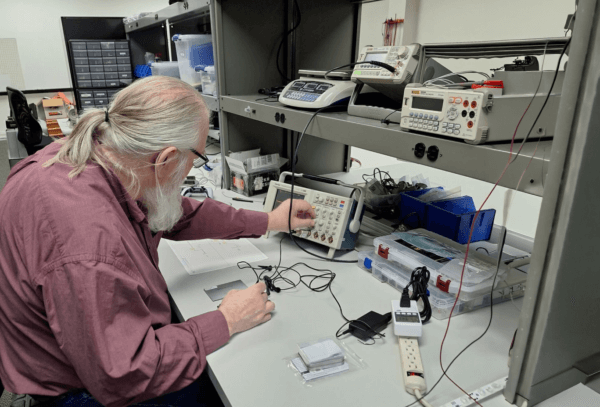
Sit in on a Q&A with one of the best to ever do it, Joe Egan. 2026 will mark his 40th year in the field of electrical engineering, and we’re so grateful to have his expertise on the Kickr team.
A few insights from Joe that emerging engineers may appreciate:
- Nurture your curiosity, it just might lead to your career
- Never stop mastering the fundamentals
- Creativity has value as a technical skill; cultivate it in all areas of life
- Let necessity drive invention and create solutions to real problems
- Invest in continuous learning and ongoing formal education
- Stay current with industry news (publications, journals, news, etc.)
- Lean on mentors in the electrical engineering space
About Joe: The Man, The Engineer, The Creator
- BS in Electrical Engineering from the University of Florida, Gainesville
- Graduate Studies in Electrical Engineering from the University of Texas, Dallas
- 39 years (going on 40) as a Design and Applications Engineer in the electronics space
- The inventor or co-inventor of several patented items
- He spends his free time with family, building and flying model aircraft, maintaining the family vehicles, trying to play the guitar, or woodworking
- His favorite project was a kinetic art sculpture for a major company trade show, featuring 20 3D-printed birds mounted on rods of varying lengths that rotated around offset centers. Joe was responsible for system architecture, control design, and electronics design on that project, and the client loved it so much that they brought it back and installed it in their headquarters!
What first drew you to electrical engineering?
One of my uncles was an electrician who owned a small electrical contracting company. When I was a young boy, I would visit his shop, where he built small battery-powered gadgets for me to take home.
One of these gadgets was a collection of small light bulbs, motors, switches, and similar components mounted on a small piece of plywood. I spent hours playing with the wires, trying to figure out how it all worked.
My father recognized my interest and would purchase small kits at RadioShack for me to build. I would take apart old radios and appliances, and managed to get some of them back together.
What attracted you to work at Kickr, and what has your journey here been like?
What attracted me most is the wide range of project types Kickr works on. My engineering interests and experience are broad, and the mix of projects keeps things interesting.
With 39 years of experience, what do you think sets a strong electrical engineer apart?
In my opinion, the best engineers have a strong command of fundamentals, stay current with the state of the art, and pursue creativity or inventiveness.
Since the electrical portion of a design is often used in conjunction with other engineering disciplines within a system, it is helpful to have some understanding of those disciplines.
What’s the most challenging project you’ve worked on at Kickr, and how did the team overcome it?
The most technically challenging electrical project I have worked on was probably a communications hub/bridge that we designed for a client.
- The unit supported Wi-Fi, Bluetooth, HaLow (900 MHz), Cellular Modem, and Ethernet
- It had to be powered by either 120VAC or PoE, be compact, and cost was critical
- This required an SoC chip-down solution rather than an integrated module
- We had to implement 800MHz DDR SDRAM and all the other high-speed interfaces
I collaborated with another electrical engineer to generate all schematics and PCB Layouts. We worked with one of our IDs who developed the product enclosures and determined the proper PCB outlines and critical component placements.
How do your hobbies, like woodworking or building model aircraft, influence your engineering approach?
The model aircraft, especially contemporary models, contain a fair amount of interesting electronics. The most interesting are multi-rotor aircraft (quadcopters and similar platforms), which require advanced electronics for stabilization and navigation.
Solutions here have been directly applicable to some Kickr projects, and model building and woodworking require a good degree of creativity.
You’re an inventor on several patents. What inspires your creativity and innovation?
I suppose this is cliché, but necessity is a strong motivator for innovation. When existing solutions are unacceptable, new approaches must be explored.
What advice would you give to someone just starting in electrical engineering?
- Continuously work to strengthen and broaden your understanding of the fundamentals
- Seek out experienced mentors in the workplace and learn from their experience
- Subscribe to trade publications and IEEE journals applicable to your current position
- Consider continuing your formal education (especially on the technical side)
- Seek out employers that offer funds for continuing education
How do you approach the design of electronics for Kickr’s projects? What’s your process from concept to execution?
The mix of projects we take on at Kickr is very broad in both scope and complexity. Project outputs range from building one-off proof-of-concept prototypes to preparing design packages for volume production.
A full response to this question would fill an entire document, but a simplified flow would be:
- First, we establish requirements and define project outputs to support system architecture design
- Then, we review the changes being integrated in a refinement pass
- Once the architecture is complete, the detailed design begins, with the scope being very project-dependent
- Outputs at this stage may include Schematic Diagrams, PCB Layouts, Wiring Diagrams, Cables, and a Bill of Materials (BOM)
- Projects with firmware programming require detailed documentation
- To bring up the prototype, we create an integration plan
- We conduct design reviews, and changes are integrated
- Hardware is fabricated and assembled, and testing begins
Is there a project at Kickr that taught you something new or pushed you out of your comfort zone?
We developed a laboratory instrument that used an optical waveguide for interferometry. I had never worked with this technology, so it presented a learning curve.
Fortunately, several technical papers were available, and we also had access to some of the primary research team members, so I learned a lot.
When working on Kickr projects, how do you ensure reliability and quality in your systems?
A full response here would be extensive, but a general approach includes:
- Best practices and accurate calculations to ensure components are not overstressed
- Ensuring designs have proper margins (switching threshold, timing, etc.)
- Addressing what a system is supposed to do
- Properly and safely handling exceptions based on my extensive experience
Work with Joe on your hardware development project when you collaborate with Kickr! Connect with our team today to see how it works.