

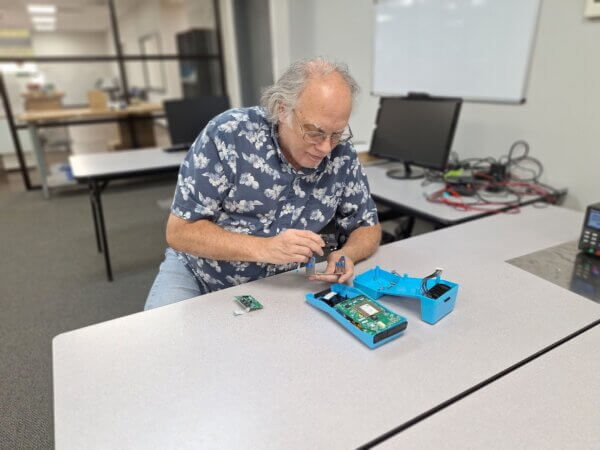
Some people discover their calling. Tim Zollers was too busy living it to notice, until someone finally gave it a name.
Ask Tim Zollers when he decided to become an industrial designer, and he’ll tell you he didn’t, at least not consciously. “I had not heard of Industrial Design growing up,” he says. “I thought I’d like to design cars, so I went into Engineering.” It wasn’t until his freshman year at the University of Illinois, Urbana-Champaign, living in a dorm on the Engineering campus, that a handful of guys on his floor pointed him toward the ID program. He took a look at the curriculum and never looked back.
The revelation made a certain kind of perfect sense. Tim had spent his whole childhood doing exactly what industrial designers do, just without the title. Tinker toys. Erector sets. Dismantling and rebuilding bicycles in the backyard. Drawing contest wins in grade school. Shop class, drafting, art. And by his senior year of high school, he had a co-op position in the Plant Engineering department at Caterpillar Tractor. “It’s as if I have been preparing for a design career my entire life,” he says, and he means it without any irony.
Designing for How Things Get Made
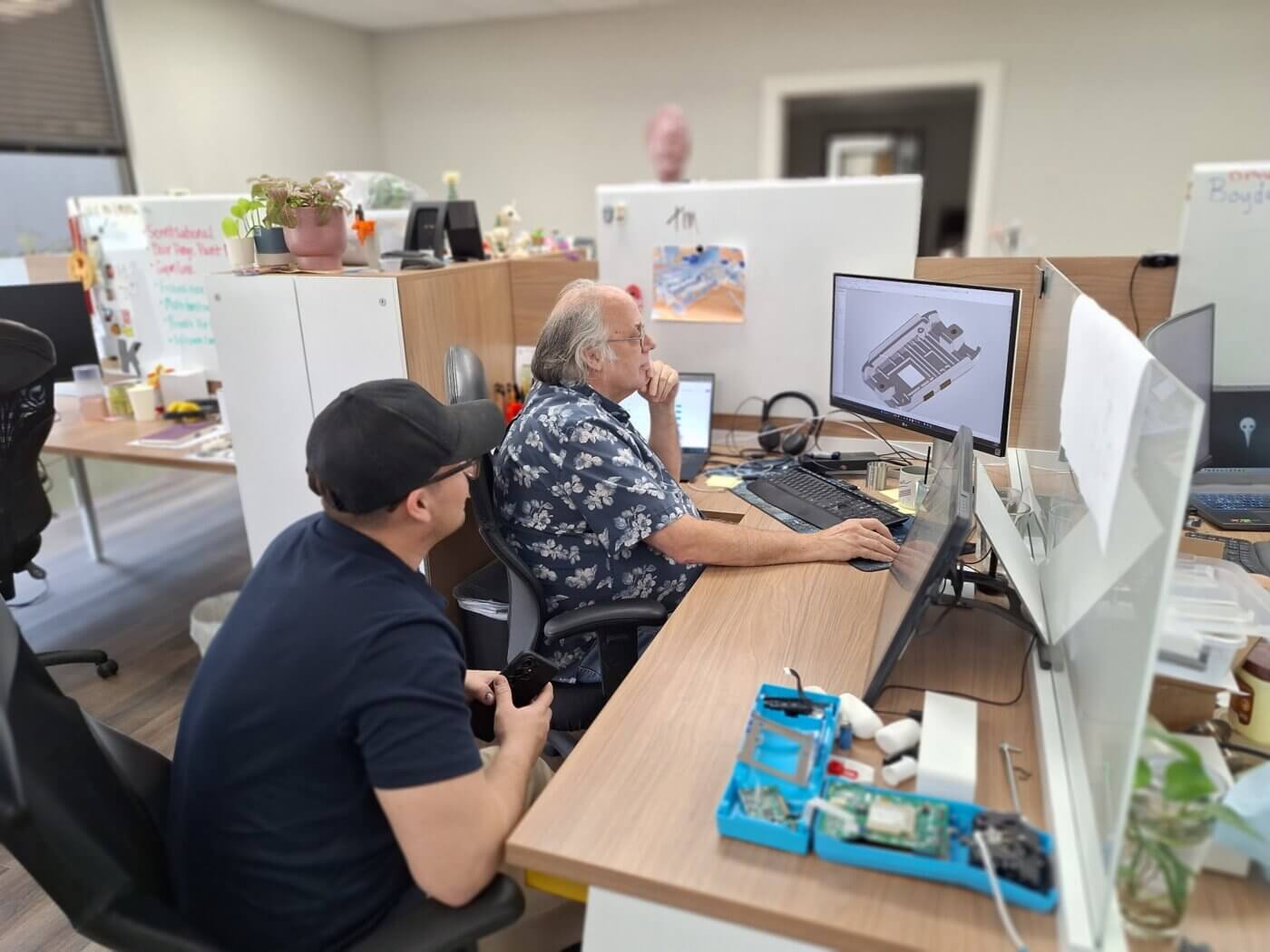
Over three decades spanning medical devices, industrial equipment, consumer products, and kinetic art, one thing has stayed constant in Tim’s approach: he designs with the factory floor already in mind. “I try to design keeping the final product and production intent in mind,” he explains. Formed sheet metal and welded tubing are perfectly reasonable for low-volume runs. But when volumes scale, the rules change, and Tim’s been around long enough to know the difference before the first sketch hits the page.
He holds that same pragmatism when it comes to new technology. 3D printing gets its due; it’s a powerful tool for rapid iteration and fit verification, but Tim is quick to note its limits. “Just because something can be 3D printed, that doesn’t mean it can be injection molded.” It’s the kind of observation that only comes from building things that actually had to ship.
“Whatever you’re designing cannot just be pretty — it needs to be manufacturable. Industrial designers and mechanical engineers can play nice together.”
The Project That Still Stands Out
Tim has worked on everything from medical devices to motorcycles, from brooms engineered to stand upright in the middle of a room to salsa bowl attachments that proved a skeptic’s spouse wrong. But when asked for a favorite, he doesn’t hesitate: a mechanical kinetic sculpture for a trade show exhibit.
The scope was staggering. The team designed a system that could be assembled and struck like a trade show booth, but at the center of it was a 12-foot diameter ring suspended 14 feet in the air, with 40 objects in synchronized motion driven by 20 motors. Custom mechanical components. Custom PCBAs. Custom firmware written to keep everything in sync over hours, even days, of continuous operation. The spinning arms had to be balanced, achieved through a clever combination of hollow tubes for the longer arms and solid bars for the shorter ones. Drive hubs needed to be manually pre-positioned before startup, solved with a split hub secured by magnets that worked with, not against, the cogged belt system.
“This could be a book in itself,” Tim says. The toughest part? The firmware. “It took a lot of trial and error, but in the end it worked flawlessly.”
The Hard Truth About Getting to Market
Tim’s favorite projects are the ones that make it to production. He’s seen enough of both outcomes to know what separates them, and his answer is refreshingly direct: money. Not lack of skill, not lack of vision. “Getting a project to a point where there is a functional prototype that checks all the boxes is only part of the battle.”
Corporations can pull back for any number of internal reasons. Individual inventors, whom Tim has a particular soft spot for, sometimes don’t account for the full cost of tooling and mass production. “Their idea might be brilliant, but without knowing their market or its potential, those two things may doom it.” The projects that do make it through, the ones where a client found a manufacturing partner or built it themselves, those stick with him. “It makes me feel good to know that what I designed helped them on their path to success.”
What He’d Tell His Younger Self
Tim holds several design and engineering patents, utility patents, the ones with novel mechanisms that he finds most rewarding, earned as part of a team, but he’s characteristically unattached to the recognition. “I don’t really give patents a second thought usually.”
What he does give thought to is the advice he wishes he’d received early on. It’s tight, practical, and very Tim: “Don’t be afraid to learn new things, embrace technology, and whatever you’re designing cannot just be pretty — it needs to be manufacturable.”
After 30-plus years, he’s still following his own advice. And the products keep getting made.
Tim is one of the people behind Kickr’s engineering-led approach. Have an idea that needs to be built? Let’s talk.