

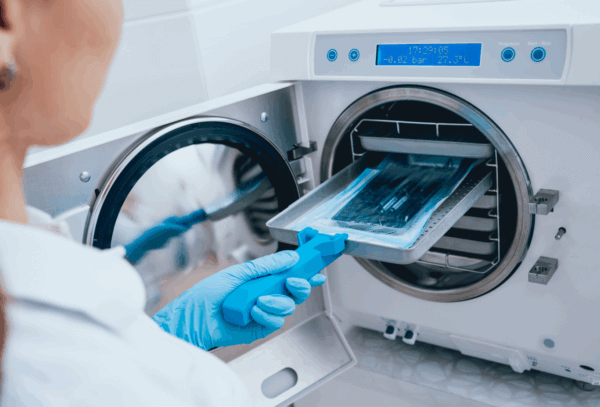
Medical devices must be safe and effective to pass official regulatory compliance. Preparing for sterilization procedures, meeting sterile packaging requirements, and conducting a multitude of tests are significant aspects of medical device development.
Official Sterilization Standards
Global standards for trusted goods, including medical devices, are established by the ISO, or the International Organization for Standardization. They create guidelines for manufacturers and product designers, who must make accommodations for the safe use of medical devices, including sterilization.
The three most applicable ISO standards are:
- ISO 17664: Requirements regarding the processing of critical and semi-critical medical devices before use or reuse.[1]
- ISO 14937: Standards and requirements for the sterilizing agent used to sterilize health care products to deactivate any potentially harmful microorganisms.[2]
- ISO 11607: Standards for sterile barrier and packaging systems to ensure medical devices remain sterile until the point of use.[3]
ISO 17664
This global standard defines critical and semi-critical medical devices as any medical device that “enters normally sterile parts of the human body,” or that “comes into contact with mucous membranes or non-intact skin,” or that “is intended to be sterilized.”[4] This does not include non-critical devices, those designed for one-time use, or textile devices.
ISO 17664 specifies the requirements for manufacturers to provide detailed processing instructions for medical devices from initial treatment at the point of use, preparation, cleaning, disinfection, and drying to inspection, packaging, sterilization, storage, and transport.[5]
ISO 14937
ISO 14937 outlines the required Quality Management System necessary to guarantee the appropriate characterization of the sterilizing agent as well as the development, validation, and routine monitoring and control of the recommended sterilization process.[6] The purpose of this requirement is to reduce exposure to possible microorganisms and contaminants and to sterilize previously non-sterile equipment and devices before use.
ISO 11607
ISO 11067 outlines the process and requirements for designing and developing a sterile, safe, and effective packaging system for a medical device. This global standard encompasses a wide range of potential materials, applicable medical devices, packaging system designs, and recommended sterilization methods.[7]
What Does This Mean For You & Your Medical Device Idea?
The sterilization method for a medical device must be considered during the design and manufacturing process to ensure safety and performance. According to the FDA, testing the sterilization process may include Chemical Indicator (CI) testing, thermal cycling, sterilant residue testing, endotoxin testing, bioburden testing, Biological Indicator (BI) testing, and others.[8]
Clearly, this is a highly complex and detailed process that can be overwhelming. Working with us puts our design, engineering, and medical device development experience in your corner to ensure all regulatory compliance measures are met.
If you’re working on an idea for a medical device, we’d love to help you get it out into the world to improve modern healthcare for patients and providers. Connect with the Kickr Design team here to discuss a free cost estimate.
Sources:
[1][4][5]ISO 17664-1:2021. ISO. (2021, July 6). https://www.iso.org/standard/81720.html
[2][6]ISO 14937:2009 – Sterilization of health care products — General requirements for characterization of a sterilizing agent and the development, validation and routine control of a sterilization process for medical devices. (n.d.-g). https://www.iso.org/standard/44954.html
[3][7]ISO 11607-1:2019. ISO. (2024, July 5). https://www.iso.org/standard/70799.html
[8]Affairs, O. of R. (n.d.). Sterilization process controls. U.S. Food and Drug Administration. https://www.fda.gov/inspections-compliance-enforcement-and-criminal-investigations/inspection-guides/sterilization-process-controls