
Hardware moves at the speed of the shop and resources you have access to. That one fact should shape every question you ask a program before you sign anything. Not the logo on the sweatshirt or the demo day guest list. Whether you can get your hands on a machine this week and whether someone who has actually built something is standing close enough to look at your design with you.
Here are the questions worth asking before joining a hardtech incubator program.
How much real product experience can I reach, and how often?
This is the most important question, and it’s the one people most often forget to ask. Get the specifics. How many engineers are on staff? How many years have they spent bringing physical products to market? How much of their time is included in what you’re paying? How much is billable when you have a question?
Kickr Labs sits on top of Kickr’s engineering team, which represents over 1,000 years of collective product design and engineering experience actually getting products to market. Membership includes a dedicated hour every month with any of our engineers for brainstorming, design reviews, or help getting unstuck, plus business and product strategy office hours and reduced-cost engineering and prototyping services when a project grows past what an hour (or your team) can cover. There is nothing more debilitating than making the wrong design choice in your hardware engineering process, only to find out weeks later that you should have gone a different direction. It’s not always possible, but by leveraging deep product and design expertise precisely when you need it and in-person, you can shortcut design iterations early.
A design review at the right moment can save a founder valuable time and help set them up for longer-term success. Consider a design choice early on that could have cost implications once you are in pilot production. A choice could seem insignificant when making only a few prototypes on your own 3D printer that take 24 hours to print, but if you need to scale to even dozens quickly, those same early design choices could handicap your company and force late-stage re-design with higher cost and timeline implications. Access to real engineers, on-site and immediately, helps mitigate those risks.
What can I actually build there?
Ask for the equipment list, then ask how you get on it. There is a meaningful difference between a room of 3D printers and a working shop.
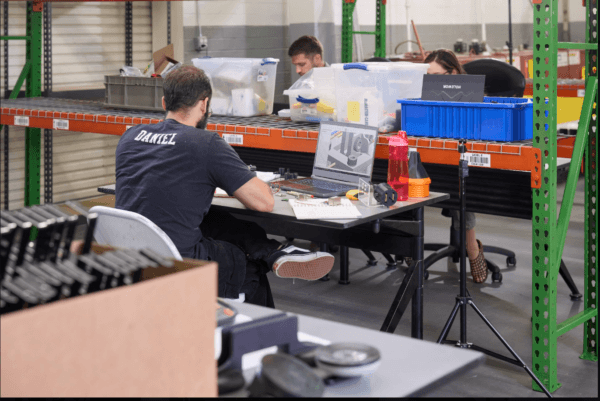
The product realization lab at Kickr Labs is 8,000 square feet with 3D printing, laser cutting, a machine shop, a wood shop, welding, fabric goods, and on-site injection molding, which means you can go from a printed concept to a molded part without shipping your design across the country and waiting on a quote. It is not an open maker space. It’s a professional workshop shared with our engineering staff and opened to select founders building a real product, which is why the equipment and the expertise to use it are available precisely when you need it.
The point of all of it is to get you out of the garage. You need somewhere to build, hold inventory, assemble, and test, and those are four different things. So ask the unglamorous questions. Is there storage? Is there a bench that stays yours between visits? Is there a bay when you outgrow the bench? Founders discover the shipping and receiving problem at the worst possible moment, usually the week their first production run lands.
While you’re at it, ask how fast you can iterate when something fails. A program with fabrication in the building turns a design change in days. A program that outsources it turns the same change in weeks.
Do I have to leave where I am now to join?
The right answer is no, and if a program tells you otherwise, ask why. Kickr Labs is an AND, not an OR. If you’re already in an accelerator or incubator, stay in it. If you have your own office or warehouse, keep it. None of this conflicts with a membership that puts 1,000 years of experience within reach of your next design question.
Will this help me when it’s time to raise funds?
Hardware raises differently than software, and general-purpose investor intros don’t help much when your round depends on someone understanding FDA pathways or tooling amortization. Ask who the program actually knows and how recently they’ve talked.
We’re actively working on relationships with local venture funds and angel groups. We’ve also brought on a fundraising expert who works with founders on their capital raises when they reach that point.
The honest framing is that no program should promise you a raise. What they can promise is that when you get there, you won’t be starting from zero.
Who else is in the room?
Peer community is the thing founders underrate and then rely on most. The value isn’t networking in the LinkedIn sense. It’s the person two benches over who already solved your connector problem, already found a machinist who answers email, already learned which contract manufacturer stops returning calls at 5,000 unit MOQs.
Not only will you be alongside founders, but industry professionals as well. Kickr Labs welcomes industry engineering directors and R&D directors who also want to break out of their team’s engineering box and gain perspective from Kickr Design’s broad experience across industries, so as a hardware founder you will be able to rub shoulders with professionals who manage manufacturing and product companies in the tens to hundreds of millions in revenue. Their deep industry-specific experience is just a Kickr Labs social hour away. What we’re building is specifically a hardware, medical device, and physical product community in the Southeast, which is different than a general startup coworking floor. Ask who the members are, what they’re building, and whether the events are real. Ours are on a public calendar, which is a reasonable thing to ask any program for.
What does it cost, and what am I giving up?
Many hardtech programs trade capital for equity, generally somewhere in the range of 4-8%. That can be a good deal, and a partner with ownership has a reason to keep answering the phone.
It isn’t the only structure available, though. Kickr Labs memberships start at $250/month, and our Product Realization Lab starts at $500/mo, with an optional dedicated workbench and storage. No equity tied to any of it. With even the most basic membership, founders gain critical access to Kickr Design’s experienced engineers and management team on a weekly basis for free to help brainstorm, solve problems, and overcome obstacles. For founders who want the same structured path, the Founder Accelerator Program is a curated cohort with a guided curriculum, milestone-based deliverables, and eligibility for Stage II investment for teams that hit their marks.
Whatever model you’re evaluating, price the space, the tools, and the engineering hours on the open market and decide if it’s worth it.
Bring these questions to us
Ask us all of it! What’s included and what isn’t, what the shop schedule really looks like, who you’d be sitting next to, what happens when you get stuck, and more. We would rather answer honestly and help you land in the right place than talk you into the wrong one.
Better yet, come see the Kickr Labs space! Schedule a visit or reach out to our Kickr Labs team here.