
Q&A with Lee Farris, Kickr Senior Mechanical Engineer
Most people picture prototyping as a workshop scene with tools out, sparks flying, a part taking shape on day one. The reality inside a product development lab looks different. The first weeks of a project happen on whiteboards and laptops, long before anything gets printed or cut. We asked Kickr Mechanical Engineer, Lee Farris, to walk us through what actually happens when a new idea lands on his desk, from internal kickoff to the first physical build.
What actually happens first on a new project
What’s the first thing you actually do when a new prototype hits your bench?
The stage at which I learn about a new project/design can vary significantly– sometimes I am called in to a sales call to help evaluate if the project is realistic, and if so, estimate the tasks and challenges to get to the client’s desired output. Sometimes I am assigned to a new project, and there will be some documentation to review prior to an internal kickoff – this always includes a description of the idea and a sales agreement, and sometimes includes sketches, CAD models, or even physical parts. The internal kickoff is where we really get the briefing from the sales and technical teams, and there will inevitably be dozens of questions that I’ll have about intent, timeline, budget, expectations, technical capability, inspiration, scope, expectations, etc.
Who’s in the room at kickoff
Who’s in the room with you on day one of a new prototype, and what role does each person play?
Mechanical, electrical, industrial design, and project lead are typically all there for our internal kickoff. The meeting is generally led by the salesperson who estimated the work, as they have the most direct experience with the client and the best idea of scope. Scope is almost always the main focus of these meetings, but it can also involve discussions of feasibility (there are lots of ideas that work in your head, but won’t work in physical reality!), and we also check to make sure the team that the project manager has assembled will be sufficient to achieve the scope within the timeline and budget.
Why the tools don’t come out first
What does the workspace look like before you start? What’s already on the bench, what gets cleared off, what tools come out first?
Contrary to expectations, physical tools are rarely involved for the first few weeks or months of a project. Just selecting the appropriate materials for a design is often not decided until halfway through, and physical parts are often not ordered until the design is complete or nearly complete. The first tools are our brains and our laptops, for proposing mechanisms, layouts, shapes and sizes. Most early sketching is done on a dry-erase board (in group discussions) or with pen and paper. The exception to this is partial prototypes – when a feature is novel or risky, we will want to physically evaluate it to confirm that the behavior is as expected. For example, if we want to use a novel material, we may order a sample so we can handle it before choosing to use it in the design – but this is fairly rare, as using novel materials is usually quite risky.
The first question we ask: does this already exist?
What’s the first question you ask yourself when you look at a client’s concept for the first time?
Usually it is “to what extent does this exist already?”. With 8 billion minds on the planet, it is fairly rare that an idea has not been thought of in some form, and this usually means that a similar product/mechanism/device exists and can be used to evaluate all sorts of things. If it doesn’t exist (or we can’t find an example), my next question is usually, “Why not? Is this concept physically possible? Is this approach too expensive to produce? Does developing this design take more resources than expected? Does a patent already exist that has prevented people selling this?”
“Cost doesn’t matter” and other things clients don’t mean
How do you tell the difference between what the client said they want and what they actually need?
A couple of these are quite common: “cost doesn’t matter”, “it has to be done by this date,” and “it has to do everything”. There will always (always) be trade-offs between performance, price, and speed, and clients are rarely fully aware of the extremes those can reach if they are totally neglected. A good recent example is a client who wanted to move so quickly that they required a new physical prototype every week. While we were able to do it, reaching that pace resulted in expedited production and shipping costs that not only ballooned prototype costs nearly 5x, it also slowed the development process down significantly because the engineering team was spending more time producing/testing/shipping/reviewing prototypes than they were actually progressing the design towards the goals.
Speed vs. polish: a real tradeoff
What’s a real example of a tradeoff you made in the first 24 hours of a prototype, where you chose speed over polish or vice versa? What drove that call?
We try as much as possible to let the clients make those decisions by presenting the pros and cons – but on occasion we do need to make such a call without input due to time constraints or limited options. In the first 24 hours, that is almost never the case – usually such decisions are made in the last 24 hours – when ordered parts are delayed, or when reworking a part that has a cosmetic blemish would cost thousands of dollars. A recent example is a pair of 3D prints that threaded together to make a watertight seal – the threads stripped during assembly, and so the parts could not be attached together. Reprinting the parts would have taken several days and significant cost – so we manually removed the threads with a Dremel and sealed the parts together with hot-melt glue. This allowed us to test the pressurized system (the pump, nozzles, etc.) without significant extra delay or expense, knowing that we were likely to make new prints in the future anyway based on the feedback from that performance testing.
The tools a first prototype actually touches
What tools, machines, or software does a first-day prototype actually touch in your lab?
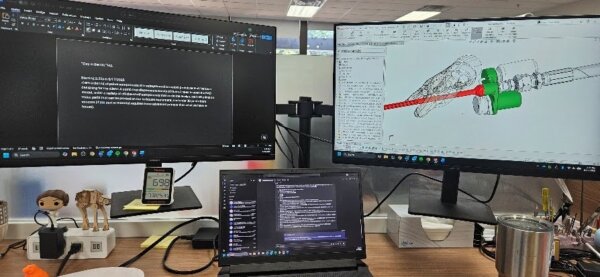
A design usually goes from whiteboard, to notebook, to 3D CAD model (SolidWorks if functionality is the primary focus, ZBrush if aesthetics or marketing are the focus). There is no one 3D printer or common hand tool across all projects, but it is common to print larger parts on one of the variety of Bambu FDM printers, and smaller or more detailed parts on one of the variety of Formlabs SLA printers. A workbench is custom for each design, with tools from every corner of the workshop, often including tools ordered specifically for that project. Even for a simple straight cut, there are over a dozen commonly used tools that must be appropriately selected for the material, dimensions, precision and desired finish (table saw, laser cutter, circular saw, bandsaw, jeweler’s saw, reciprocating saw, miter saw, hacksaw, Dremel, plasma cutter, lathe, end mill, etc.).
How many revisions happen in a day (fewer than you’d think)
How many revisions do you typically run on a first prototype in a single day?
Revisions are usually conducted on the order of days or weeks, not hours. Custom-made parts are expensive and precise. Cutting off a corner, drilling a hole in slightly the wrong place, or even sanding a surface that you shouldn’t have can result in destroying that part (see the stripped threads above) that can add weeks of delays or thousands of dollars of extra costs, so decisions to change a part are not made lightly, unless working with very cheap materials or with a large quantity of spares. Even in those cases, re-working parts by hand is time-consuming and therefore costly. So most changes are made in 3D models and reviewed by the team before parts are ordered. Exceptions might be a fastener that is too long (we could grind it shorter to fit, but the resultant screw length needs to be measured, noted, and updated in the 3D model so that the model is accurate and the correct parts are ordered for the next iteration of the design), or boring out a hole that is too tight (same documentation and model updates apply!).
What we show clients, and what we hold back
What’s the conversation with the client like?
We try to be as honest as possible with our clients – we show them everything! They are paying for our services, so they need to know what it is we’re working on and why. If they don’t understand the challenges of making their design, they also won’t understand the value we bring. Sometimes, we may not show the full details of the specific math or simulation tools used to estimate forces or predict behavior, as it can take a long time to document, and often the clients do not have the knowledge to understand the details anyway. We often shorten that information just to the conclusions – for example, this material thickness will be strong enough, or this mechanism will be the least expensive way to achieve this motion. Sometimes we even share the ideas we did NOT pursue, and why not. It prevents it from looking like we didn’t think of that, or prevents trying that option in the future if it looks like our first choice isn’t working as well as expected.
The most rewarding part of a rough first prototype
What’s the most rewarding part of handing back a first prototype, even a rough one?
For me, who always views designs critically and wants them to work “perfectly”, I’m often pleasantly surprised with how pleased a client can be just holding physical parts in their hands. Even if the hinge is a little harder to move than desired, or the surface looks a little rough, or if there is a small gap where there shouldn’t be, I think those details matter very little when someone gets to hold the physical manifestation of their idea in their hands. The feedback on early prototypes isn’t always this great! Sometimes expectations are for a perfect production-looking part that performs with no flaws as the very first physical part. This is almost never the case, and no amount of preparation can dispel that idea. But those moments when a client wells up with tears of joy, or shares how well it worked for their testing, or how excited their family or investors are about the progress – especially if we’ve come up with a clever mechanism or approach that they never even considered to achieve their goals – those are the most rewarding parts.